



5 minutes to read

Estimation of Coincident Index with Dynamic Factor Models

Introduction

Stock and Watson (1989) proposed a dynamic factor analysis to develop a coincident index that measures the state of overall economic activity. The model adopted by authors “…is based on the notion that co-movements in many macroeconomic variables have a common element that can be captured by a single underlying, unobserved variable.” This single-index framework is quite flexible and can effectively be used for general purpose dimensional reduction analysis, where variables of interest are assumed to share a common factor.

Application to Sectoral Inflation Expectations

Economic agents may differ with respect to their inflation expectations as they are exposed to different set of items in the CPI basket. They may also assign different weights to changes in the prices of their preferred goods and services. Still, it is safe to assume that there might be a common component that has an impact on each agent’s perception or behavior towards price changes (COINCIDENT_DATA.WF1).

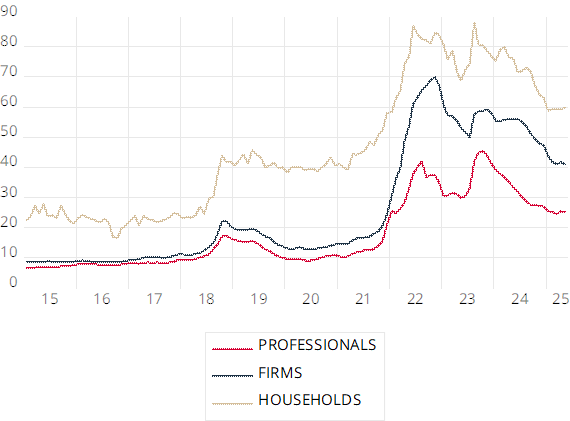
Figure 1 below shows the 12-months ahead expectations of annual inflation for market professionals, firms and households in Türkiye (COINCIDENT_EXAMPLE.PRG). Households have the highest inflation expectations, whereas market professionals have the lowest. There are large differences in the levels of expectations, but correlations among them are higher than 0.95.

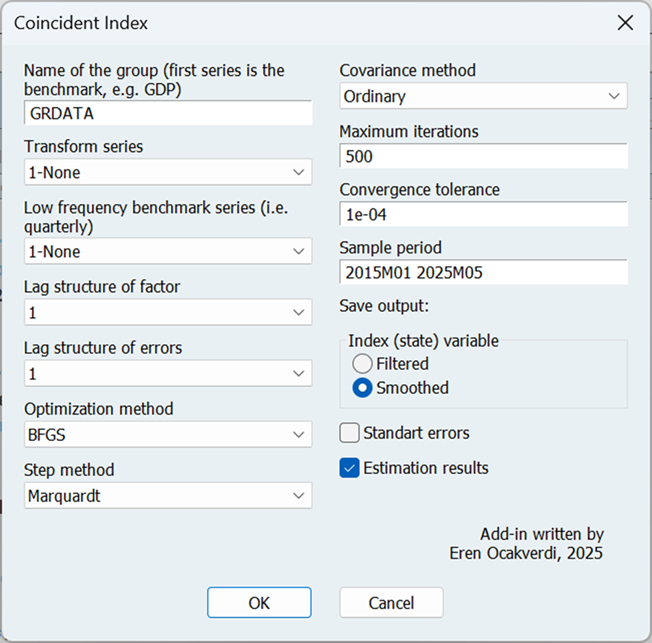
First, we start by estimating the model with imposing an AR(1) lag structure on both factor and measurement errors without applying any transformation to the data. And then, using the add-in, alternative lag structures are estimated for comparison purposes. Calling the add-in from the equation object will prompt the GUI (see Figure 2).

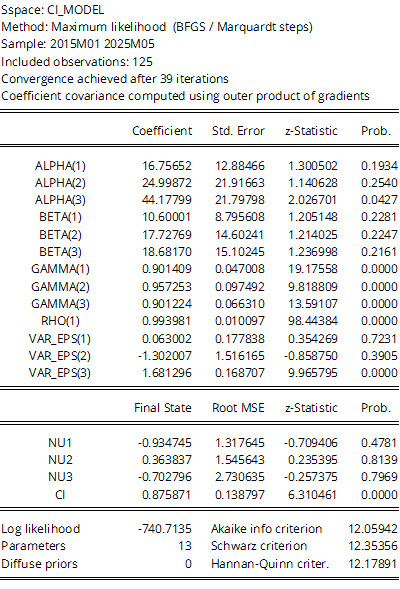
Since we have three dependent variables, thirteen hyperparameters (3×4+1) and four state variables (3+1) are estimated. Estimated value of rho, ρ_1, close to 1 indicates that the latent factor might have a stochastic trend and gammas, γ_m, higher than 0.9 also denote persistent behavior around the latent factor (see Table 1).

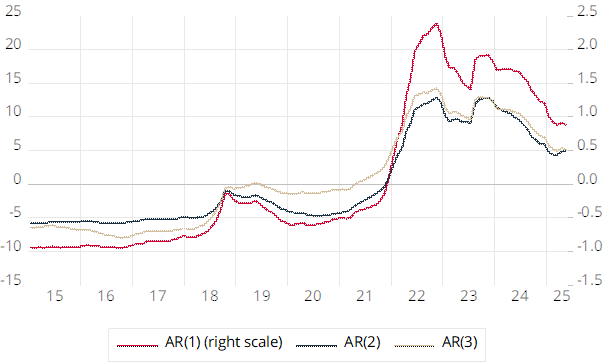
The impact of a 1 pp change in the underlying factor on the expectations of households is around 19 pp and is slightly higher than that of firms (i.e. and ). Market professionals, however, seem to be relatively less sensitive to such change (i.e. ). Differences in the level of expectations are captured by scale parameters (i.e. alphas, ). Note that alternative lag structures might lead to different output (see Figure 3).

We can use a reference (low frequency) series as a benchmark for extracting the common factor. In that case, we’ll need an additional measurement equation to relate the reference series to unobserved index variable.Here, the reference series, , is annual change in the GDP deflator to reflect general price dynamics and is observed every three months.

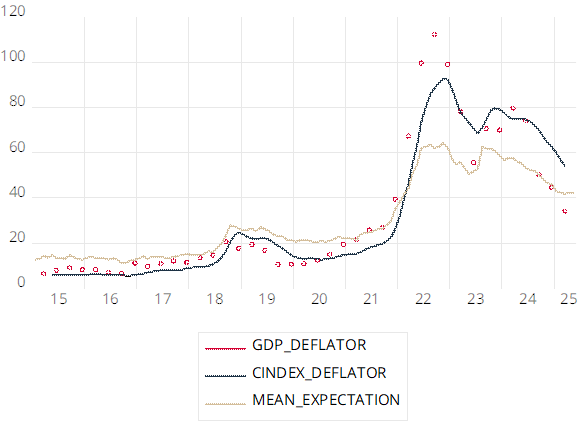
Until the pandemic, average of sectoral expectations systematically overshoots the actual data, whereas estimated index does a better job in fitting. Realization of very high inflation prints thereafter causes significant jumps in both indicators, but the index still outperforms the average of sectoral expectations in capturing the level shift until the start of disinflation (see Figure 4).

In addition to nowcasting or estimating business conditions, single-index framework can also be quite useful in dimensional reduction problems, where you need to summarize the information at hand and distill it down to a single indicator.

Related Industries

Recommended for you